Riot and Frolic

a mostly ballroom dance, but also a bunch of other stuff, blog

  • I wrote this with ballroom dancing in mind, but apply it to whatever you want.

    #1 Start

    While it might go without saying, to start doing something, you must actually TAKE THE FIRST STEP. HAHAHAHAHA.  #dancejoke

    Ironically, the first step to dancing is NOT dancing.  So switch apps on your phone and find a nearby studio or class.  Make sure it’s for ballroom dancing and not little kids’ tap/jazz/ballet.  Maybe check the Google reviews.  GOLD STAR if you know a ballroomer and they give you a recommendation of a place. 

    Call them.  They’ll love it.

    If you have something in particular in mind, like a wedding that you’re attending, or you saw "Dancing With The Stars" and love it, or you really dig Salsa music, make sure you tell the person you’re talking to about that.  They’ll love knowing a little more about why you’re beginning and they'll be able to steer you in the right direction quicker. 

     #2 Attend a class

    Whether it’s a group shindig through community education or a private lesson through that local studio, DO IT.  It’ll be a little embarrassing and a little fun and you’ll probably blush four times and giggle more than you think is proper for someone your age, but don’t worry.  We’ve all been there.  Was it enjoyable?  Do you want to do it again?  Well…

     #3 Practice

    Even if you have no idea what you’re doing.  Put on some music (maybe you remember a song that was played during that blur of a first class or GOLD STAR #2, maybe you asked your teach for some music suggestions), but try to recall those two moves you learned by moving your personhood around the room.  Mime your partner’s existence if you don’t have a real one handy.  Screw up terribly and feel silly.  But move.  It’ll make the next lesson so much easier.

    But FOR GOD’S SAKE, DON’T CHECK YOUTUBE.  [You will go down a rabbit hole of not-practicing and probably stumble upon a horrible and very wrong tutorial. Just use your brain and memory.  It’s good exercise for those neurons AND your body.]

     #4 Listen

    Go to another lesson and listen to all those directions that the teacher is saying and apply them as much as you can. 

    NOTICE I DIDN’T SAY “TALK”.  Especially if you’re going to lessons with a partner, it’s so very easy to tell them what they are doing wrong and not focusing on what you are learning.  It’s not a competition to see who “gets it” faster, because ballroom dancing is the ultimate teamwork exercise.  It is also called “partner dancing” and YOU must learn how to dance with a partner by doing YOUR part correctly.  And THAT is the best way to support your partner, not by pointing out their mistakes.  Until you have your part down, rest content that your partner is listening as well and is attempting to master their own part.

    BUT STILL ASK QUESTIONS.  You’ll definitely be learning a new set of vocabulary words, so don’t be afraid to ask questions.  Like our teachers have always told us, if you have a question, other people have that same question.  To note, my favorite question of all time was, “Where are my hips and how do I move them?”  I answered it seriously, even though I think it was in jest.  Maybe.

     #5 Have fun.

    We were all beginners once and connecting with a partner (of any level) is a joyful event.  If you come across some bummer on the dance floor who is cramping your style by being judgemental/condescending/overly physical/etc., that person is lame and you do not need to dance with that person.  Dance with whoever makes you feel happy!*

    Go out dancing.  At a bar.  Or a club.  Go to as many group classes as you can.  Dance in your kitchen while you’re making dinner.  Listen to music you never would have unless you had stumbled in [and danced out] of a studio.  Make new friends.  Watch movies with a greater appreciation of the dance scenes.  Make security guards happy by dancing to music when you’re alone in the elevator (but still on a camera).  Try a new dance.  Take the floor at that wedding.  ENJOY YOURSELF.

    022acbf093a179295ed4304ef19bb148

    * There's a shirt AND a discount code for 10% off your order [use: riotandfrolic!] for that. 

  • As far as post-partum dancing goes, I've been around the block a few times.  Well, six times.  I've basically run a marathon of post-partum dancing.  And yet every time I hit the road after getting a new kid, I'm astounded by the facts of dance I'm faced with.

    Fun Facts About Dancing After Pregnancy

    A. Dancing is a workout. 

    WHAAAAAA?  I know.  You're surprised. [No, you're not.  I see you sweating 10 minutes into your lesson.]  But as a professional ballroomer, it's often easy to forget that even the basics danced at a beginner level can be a killer workout.  [Maybe you forgot that part, though!]

    Por ejemplo, while visiting the studio with newborn Baby #1, The G and I decided to do a little Rumba while our co-workers ogled our new addition.  Very little Rumba, it was.  One box in, I realized OH I HAVE NO ABS EVERYTHING HURTS AND I'M DYING.  

    Reality check: your abdominal muscles often separate down the middle in this fun way called Diastasis Recti when you're preggo and you have to fix it so you can live your life and do your Rumba boxes and have a great pelvic floor and not pee your pants when you sneeze.  

    [I recommend this program, The Mutu System, and will continue to until I stop hearing about adult diapers.]

    B. Everything is different.

    I swear just a couple months ago, my développés were SKY HIGH and then a couple more weeks went by and THE BELLY IS THE LIMIT, so the obstruction, and not my waining strength, is to blame and then a couple more weeks went by and during practice THERE IS A GLASS CEILING ON THESE KICKS OF MINE because no matter how active everyone else thinks I am during pregnancy, my strength and flexibility has atrophied a little, but my phantom kick memory of those extensions is still very strong.  WHY WON'T THAT LEG GO HIGHER?  I SWEAR IT USED TO. 

    Reality check: Mama, you still got it, but you might not have it… yet.  Like all those annoying doctors say, give yourself some time to recover (more than a week!), mentally and physically from all those hormones, life changes, and schedule "adjustments" before chucking yourself back in to the Expectations and Goals [and maybe leave out the Should Be parts].

    C. What are all these jiggly bits? 

    Boobs, for some of us previously unendowed, are an added attraction, but an growing impediment to those already in the know.  You still look five months pregnant, but not in the tight, "hey, there's something in there" kind of way, but in the "hey, nothing's in there and my guts are still settling into their proper place" way.  It seems like you should be able to "suck it in" or something, but…

    Reality check: blah blah, nine months to put it on, blah blah, nine months to take it off ugh blah TRUE.

    AlarmedWarpedBassethound-max-1mb

    D. Where is your center?

    I don't know!  Where is my center?  Nine months ago, I had a pretty good understanding of it, then it shifted down and forward, which was kind of neat, but now, it's floating in the ether until I get those ab muscles under control.  My poor partner feels the same way, trying to find some connection to me while dancing.

    Reality check: when you start to practice again, you'll have some remedial connection work to do.  Warn your partner that it might be slow-going ahead of time because…

    E. Your hormones are making practice an extra-thin ice territory.

    Whether you're practicing solo, en duo, or surrounded by your favorite nonet in group class, you will face a variety of strong emotions in a short amount of time due to your ever-loving/hating/frustrating hormones, especially when faced with the little adversity of getting your groove back. 

    Reality check: how much your fellow dancers will be exposed to your post-partum "personality" is a little hard to veil, so be prepared with some Kleenex and friendly faces to welcome you back to the studio.

    F. Everything is the same. 

    Joints are creaky and choreography is rusty and maybe I refer to my toes as "my tootsies" too often, but my love for dance is so so cheesy and deep and still intact.

    0b9d0c9b5310a6670d7c6401e11ebb23

    Note: OMG I'm not a doctor and everyone is different, so if you really need help, get the advice of a medical professional, not a ballroom one.

  • Sometimes I forget how life is after I bring a new baby home from the hospital.  You'd thnk I remember by now, what with 5 of these experiences in my pocket, but NO.

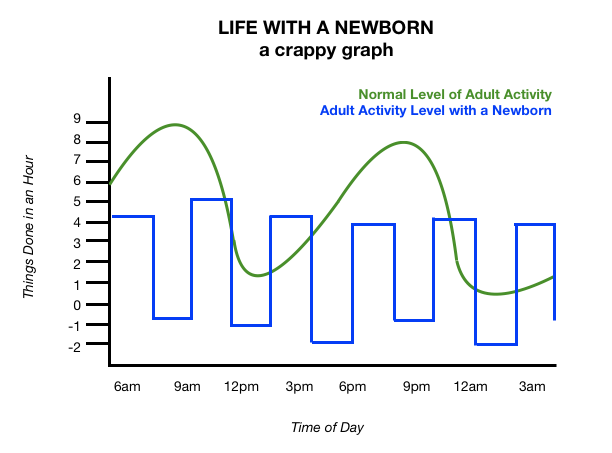
    Since momnesia is real, I decided to make myself a graph as a visual reminder of what to expect when I'm no longer expecting, and just expected. Like, to do stuff. 


    Screen Shot 2018-09-20 at 9.18.25 AM

    On a usual day, I would wake up in the morning (1), make a cup of coffee (2), make lunches for the school kids (3), wash some dishes (4), start a load of laundry (5), and make a list of three very necessary things to get done that day (6).  

    Nothing too earth shattering.  Just the morning routine.  

    Inactivity

    But now, somewhere in the middle of getting a sinkful of soapy water, this new baby needs to eat and he's not at that cool baby stage (several months down the road, Kathryn) where he can hold a bottle, so I drop everything and sit on the couch for 20 minutes.  

    While this could be a restful respite from the rat race of being a normal human, there's only so much social media one wants to consume, I discovered.  And only so many words in ANY book one can read.  And only so many shows that will capture one's attention on Netflix.  Even the glow of meditating wears off after the hundredth "break" in two weeks.

    (For those who need help with my math: let's say babies eat 8 times a day minimum every day, that's 56 times per week, which is at least 18 hours a week, which is longer than the average season of a sitcom, more time than it would take to read the entire Hunger Games series, and about twice as long as even the most die-hard Tweeter is on social media each week.)

    Don't get me wrong: I dig spending some time bonding with my child.  I make eye contact and talk to him and all that goobery mom/baby stuff.  

    But I also want to eat.  

    I want to eat a sandwich with two hands.  Not a possibility, you say, bebe?  One handed sandwich eating is required?  Well, now you are my napkin, baby.

    Less Than Inactivity

    Did you notice the blue line actually goes BELOW zero?  

    How can one get less than nothing done? you might ask yourself.  

    When a normal person goes to sleep, they get through all those groovy sleep cycles and their body and brain repairs itself in that miraculous way that sleep does.  

    When a newborn parent goes to sleep, your sleep cycle is at the mercy of a tiny totalitarian who might like to sleep in your armpit, or sleep when vertical and being walked AND ONLY WALKED, or who might want to tell you all their baby secrets at 2:11am, or who might want to tell the neighbors all your secrets at 2:11am. These small dictators might wake up once or 12 times at night and it cannot be predicted.  CANNOT!

    Those times in your youth when you complained about that [rejuvenating] 5 hour night of sleep you got?  You'd settle for four uninterrupted hours.  And the lucky synapses that would fire faster because of it.

    Activity

    During those amazing minutes when I feel a bit energetic and the baby is sleeping somewhere peacefully (rascal!), I make a quick but thorough plan of attack:

    • run upstairs (OMG QUIETLY) and grab my laundry and that book I was reading and the stamps to mail thank you cards
    • run downstairs (STILL QUIETLY, YOU ELEPHANT!) and throw the laundry in
    • back to the main floor to wash that tepid sinkful of dishes (QUICKLY, I HEAR STIRRING IN THE BASSINET)
    • throw together a smoothie bowl (IT'S TOO LATE, HE'S AWAKE; I'M GONNA RUN THE BLENDER)
    • balance your bowl on the iPad on your book with a spoon in your mouth and a water bottle (DRINK ALL THE FLUIDS) and run to grab baby before he loses his shiz.

    It is less than the average adult might accomplish, and yet, I WANT AN AWARD.  Or some cake.  

    I'd definitely settle for cake.

    1a352d5aac91e5f531944177e2a753bf

  • The Children's Museum is a great place to bring your kids.  There's interactive exhibits, lots of room to burn energy, cool ways to learn without it feeling "learny", and, of course, other kids.

    In other words, anarchy.

    There's no telling a toddler to wait their turn to drive the fire engine. 

    There's no way for a polite 8 year old boy to tell a stubborn almost-2-year-old with a death stare that she needs to release and relent that fire engine steering wheel once she gets it. #henniebadger IMG_5930

    There's no reason a Type A nine-year-old starts off quietly organizing the play kitchen and very quickly proceeds to run a monopoly on the food trade in the neighborhood.  She puts her sister in charge of managing the farmers market and when another kid says something about The Family Business, you realize your kids started their own mafia.  

    There's a very fun interaction when a 3-year-old boy convinces a girl and her mom wearing niqabs to "Get on the dinosaur train!"

    On the plus side, I've seen few instances of bullying in this anarchic world of young people.  Literally one that seemed on purpose and then a whole bunch of other instances where some small person had no equilibrium and knocked into another small person.  

    Generally speaking, the older kids watch out for the toddlers in a completely glorious and indifferent way (casually brushing a kid's hand away from getting stuck somewhere, moving them to the side of the stairs as they cruise by) and the toddlers watch and learn covertly from the older kids.  

    As the caretakers uselessly follow their charges around, we nod and smile politely and possibly strike up a conversation, but it's not really our time or place.  But maybe it should be.  It's a pretty simple world these kids like: never stop moving, talk to everyone, stand your ground, have fun, be loud, and learn stuff.

    Boom.

    9d3b5630c247e529d61441486871ddec

  • A couple of people have compared me to Jessica Day from "The New Girl" and I usually blow it off as she's a great Every Girl who epitomizes how many of us feel from day to day.  

    But tonight, I'm excitedly sitting in my dining room listening to the lids on my cans pop.

    AKA, I'm having a JAM-boree.

    Hot JAM, it's warm in here.

    I'm canning.

    Jam.

    I've done some simple canning before.  I think only ever tomatoes.  And those are exciting enough!

    But now the bar has been raised

    There has been pectin and sugar and "setting" to worry about.  

    But a mere two hours later (the kitchen is even CLEAN; I know, shut up), 4 out of 9 half-pint jars of strawberry jam agree that I didn't totally blow it.

    The day started out innocently enough, when the crew and I picked roughly 20 pounds of berries.  And if you thought the 7 of us could destroy a "party size" bag of M&Ms, you should have seen us plow through this sign of summer.

    strawberryfieldsforsomething
    [Note: we are in the middle of Strawberry Week where we are reading awesome books such as The Little Mouse, The Red Ripe Strawberry, and the Big Hungry Bear aaaaand creepy ones like The Grey Lady and the Strawberry Snatcher, eating lots of strawberries, and Wimbledon.]

    Anyhow, I felt I had to start putting my excellent jar collection (thanks, C&J!) to use and I figured I could sneak 5 pounds of strawberries away from the fam if I threw on some Pinky & The Brain cartoons after they were all tuckered out from swimming (thanks, B&K!).  

    I read three different sets of directions about 50 times each: the recipe that came with the Sure-Jell pectin, the Ball canning website strawberry jam recipe, and The Pioneer Woman's pictorial version.

    I followed directions.

    I rejoiced when I saw my jam had set in the pot while I was taking the jars out of the water.  Because if I've learned anything from British television, it's that a runny jam is not going to cut it.

    And…

    PING

    Now 6 out 9 jars agree that I'm not a moron.

    C3dba2fad73283bc1ffe50610f3ae2c6

  • I've been trying new things lately.  They often seem weird and I often feel stupid attempting them.  Most of the time, I don't have anything but my wits and good ol' Google helping me out.

    I've Instant-Potted four things in one day so I didn't have to turn on the oven or stove.

    The garden has gotten new plants (some which have been previously ventured and failed miserably) because dammit, I'm going to grow some shit.

    I've drilled holes into plaster and lath.

    Most recently, I've tried doing more Instagram stories.  [insert laughing crying emoji here]

    I'm pretty sure I've done a lot of other cool stuff, but you get the picture.

    The fun part is that what seemed weird at first now seems pretty easy, but I had to keep trying them.  

    JUST LIKE DANCING.

    I don't know if you remember learning how to do a Rumba box (International dancers, stay with me), but it was pretty weird for most of you. The majority of you did that unnecessary tap step after your forward and back steps (forward, tap, side together, back, tap, side together), you couldn't stay on beat unless someone was counting loudly in your ear or holding you on time a bit, you often skipped and/or added a step out of nowhere, and a good quarter of you liked to rotate to the right instead of left..

    Once you get past the basic step for any dance, there are patterns that exist to expand your repertoire.  I personally teach syllabus patterns.  And I'm not your wits and ye olde Google either.  I've had pretty good training and A LOT of experience, plus I love a good rulebook. I'm also not some kook with a YouTube channel making up Quickstep (does anyone remember that lady?!). 

    I go for the super-simple NDCA syllabus patterns (with acceptable variations), not even the crazy-fun, long, and complicated Freds, Arthur Murray, or even DVIDA patterns (most of which I know for kicks).  I've heard comments that I teach weird patterns and combinations, but if you're in the learning process, aren't all unknown and unused patterns and combos weird?  

    SYLLABUS JAM

    Sweetheart [Parallel Breaks/Cuddle in Rumba] seems weird to people who haven't "cheated" their timing before or to someone who learned Turkish Towel first.  Hell, the 6-count Underarm Turn [Circle Turn] is awful to those who have stayed in Closed Position all their lives or who think Rumba will always consist of "step side together".  And turning to the right (regardless of your Rumba rotation preference in the beginning)? Get out of here.  Awkward awkward awkward!

    On the other hand, many of our students (who are mostly pro-am-ers who compete in syllabus levels) are happy to know that they have routines that fit the requirements (EVEN IF YOUR INVIGILATOR FRIEND AND HUSBAND PULL A MEAN AND HILARIOUS TRICK ON YOU AT ONE OF THE BIGGEST COMPETITIONS IN THE NATION) but don't look the same as everyone else's.  

    The next time you think you're doing something weird, realize that you're just doing something new to you and that if you keep doing it, you might like it.  

    F92771ef92b443b07449d51e4c6de265

    Two years ago: So You Want to Be a Pro – The Myths

    Five years ago: Dandelion Crowns

    Six years ago: Facts About Motherhood

  • Hey guys.

    I've been avoiding you.  

    There's something I've wanted to tell you for awhile, and I'm afraid it'll hurt your feelings, so I just stayed away.  

    But as much as the truth might hurt, the lies are hurting both of us more.  

    The fact is… There are two full levels of syllabus moves between Bronze and Open.  

    [relieved sigh]

    There it is.  

    The cold hard truth: Silver and Gold exist, have a syllabus (with variations! Bronze does as well!), and are sandwiched between Bronze and Open.  One might even say the levels are progressive from Bronze to Silver to Gold to Open.

    I feel better already.

    Oh, you want some elaboration?

    CAN DO.

    You can throw yourself into Open heats at almost any time in your dance career. (Open refers to "choreographed", meaning you can do "whatever you want", as opposed to Closed [Syllabus] events in which you have to stick to the appropriate level syllabus or lower levels' syllabi.)

    Now, I am a BIG FAN of dancing "up": using your Bronze figures in Silver and above , Silver figures in Gold and above, and Gold in Open (duh).  BUT, that's assuming you are using at least Silver technique on your Bronze patterns, Gold technique on your Silver patterns, ETCETERA. 

    And if you're doing Bronze in Open?  I expect Open Level Technique on those Bronze-y figures.  Not just Good Bronze.  

    BUT WAIT, THERE'S MORE…

    Why are you doing Bronze in Open?  Or even a basic Silver figure in Open?  

    The correct answer would be: I'm showing my foundational movements with the highest technique possible because that is beautiful expression of the dance.

    Yes, yes, very good answer, young Paduwan.

    What I've seen lately, though, does not seem to demonstrate that very good answer. 

    It seems that some Open dancers have taken mostly Bronze patterns (strictly syllabus, not even with a "creative, yet still syllabus" variation involved) and thrown in a measure or two of flash-and-trash Open thing (Hello, Step-Points in Foxtrot and Dip or Splits Trick in Rumba!) and called it a day.  And I'm guessing it's because they never learned any of those excellent Silver and Gold patterns.

    Again, if you are KILLING. IT. on those basic steps, I'm okay-ish with this routine.  

    But you're not.  

    You're doing your Bronze stuff fine and making my eyes water when you do your "Open".  

    I know those flashy moves and just the designator "Open" makes you feel like you've accomplished a great feat, but what happens when you join the "'Why Didn't I Learn This When' Club" a couple years down the road?  And more importantly, what happens when I'm the one to break it to you that your dancing needs fixin'?  I'M BEING SELFISH HERE, PEOPLE.

    Those ignored Silver and Gold syllabi?  They are SO FUN.  And necessary, even.  (Even the Bronze syllabus can afford you some sweet variations, as long as you know how to combine skills and interpret the rules to add some flair here and there.)  While you're working on those neat-o patterns in Silver and Gold, you can refine all the techniques that will make your Open exponentially easier AND MORE PLEASANT TO WATCH. (Again, with my selfish streak.)

    To summarize, I want your Open to look and be Open, and I want you to take advantage of all the progressive and cumulative skills the FOUR LEVELS OF DANCING (Bronze, Silver, Gold, and Open) afford you.  Because I want to watch you dance well (and not the alternative to that).

    Similar and nicer: Stop Trying to Grow Up So Fast

    *this does NOT apply to Open Bronze and Open Silver, for those in the NDCA circuit: those are meant for Bronze leveled dancers who want to do an Open routine, but be judged as a Bronze dancer, likewise for Silver.

    F37e4f9d3959e28b0a813b62cea7a034


  • You’re probably looking for ballroom dance fun. But maybe something else.  So here:

    (Please note that this blog is older than most of my children, so some info may be out of date.)

    Starting Out in the Ballroom

     Etiquette While You’re in the Ballroom

    Getting Better in the Ballroom

    Competitions in the Ballroom

    Jobs in the Ballroom 

    Inspiration

    Rants About the Ballroom

    Crappy Graphs

  • When one starts learning a new skill, one is usually is excited because NEW! FUN! NEW FUN!

    Then somewhere along the way, the New Fun wears off and one decides whether the new-ish skill could still be charming when it's not being fun and looks more like work and doesn't put on makeup every day.  

    When this turn happens, one is usually faced with The Learning Curve.  The often wall-like climb with few footholds that looks more intimidating and character-building in the worst way than it looks like an enjoyable pastime.

    Screen Shot 2018-03-13 at 8.48.22 AM

    Good times.

    It can awful.  But if you're feeling this way,  you're probably stuck in one of the LITERALLY SCIENTIFICALLY PROVEN STAGES OF LEARNING A PHYSICAL SKILL.  But hold on to your science pants.  I have another crappy graph for you.

    Screen Shot 2018-03-13 at 8.58.22 AM

    Got your science pants on?  Well, if one combines the Conscious Competence model (short answer: a delightful ladder of learning where one encounters Unconscious Incompetence, Conscious Incompetence, Conscious Competence, and glorious Unconscious Competence) and the Three Stages of Skill Acquisition (Cognitive [the introductory, awkward, foundation-laying stage], Associative [the refinement of basic skills], and Autonomous [a purification of skill heeding outside factors and decision-making to improve performance]), one discovers that "the path to greatness starts with sucking and spends an awful lot of time in mediocrity" [GMB].  

    Learning anything is a process, a scientifically broken down process. Do you remember learning your multiplication facts? OF COURSE YOU DON'T. Fortunately, I get to see that process every day. You start multiplication in first grade and by second grade you’re still doing the same fucking thing. And guess what? Third grade? SAME THING. By fourth grade, you kind of “know” most of the times tables, but hell if you get 100% on all your tests and don't count on your fingers sometimes. And now?  You're still are a little sketchy on 6×7. STILL. 30 YEARS LATER.

    If you think you're the only one languishing at a certain level or harrowing over the timing and foot rise of Foxtrot or tormented by the speed of your progress, YOU ARE NOT.  The choice to continue the formidable challenge of upping your physical literacy is always up to you.  But even from here, the rewards are pretty cool. 2054bca18251d0ce31e18fcd39b95957

  • Things You CANNOT Control at a Ballroom Dance Competition

    • How hot the ballroom is
    • How cold the ballroom is
    • How slick the floor is
    • How sticky the floor is
    • How crowded the floor is
    • How empty the floor is
    • How big the floor is
    • How small the floor is
    • When you dance very early
    • When you dance very late
    • When you dance all your heats in.a.row
    • When you dance all your heats spread   out   throughout   the   day
    • When they are running ahead of schedule
    • When they are running behind schedule
    • How long each heat is danced
    • What tempo the music is
    • How strong the beat is
    • What song is played
    • How many people are watching
    • How few people are watching
    • Where other couples dance
    • When other couples dance
    • How other couples dance
    • How other couples place
    • How you place
    • How much time you have in between heats if you dance more than one style
    • What your partner is doing

    Things You Can Control at a Ballroom Dance Competition

    • Your dancing
    • Your look

    Well.  That second list is short.

    Here's the hard fact about comps: the only thing you have control over is yourself.  

    BUT many of the uncontrollable aspects of competition can be managed with proper preparation of "just" your dancing and your look.

    You can practice as many RIDICULOUS situations as possible as many times as possible BECAUSE THEY ALL HAPPEN. 

    • You'll end up dancing Open American Viennese Waltz on a 12' square platform four feet off the ground for 500 executives.  
    • You'll get tripped on purpose by a drunk pro during a pro-am competition with your student.
    • You'll have to duck, bob, weave, and separate from your partner completely.
    • You'll have a wardrobe malfunction.
    • You'll dance at 1am after starting at 6am.
    • You'll get kicked, stepped on, and elbowed.  
    • You'll pause in one place for more than a measure.
    • You'll fall down.  
    • You'll forget your routine entirely.
    • You'll dance to "Inchworm" in a final.  

    Shit happens in the ballroom.  The challenge is to learn how to deal with it.  And once you learn how to deal with it, many of "problems" you have at competitions will be part of the daily routine, instead of destroying your good time on the floor.

    Challenge Your Dancing

    • Practice on floors that are too tiny (try our house! or section off a big ballroom with chairs!)
    • Practice with music that is too slow, too fast, and too long
    • Practice at peak hours in the studio, or create practice rounds with your buds (especially if they dance different levels than you!)
    • Practice at 6am and midnight
    • Hit every studio showcase, local comp, and performance opportunity available
    • Practice with your least favorite songs and genres
    • Practice by yourself! (Or sometimes with your partner next to you, but not in connection)
    • Practice with your buddies purposely getting in your way
    • Practice charging your phone before you go to sleep and setting 7 alarms so you know you won't miss your heats.
    • Practice having fun (make up a story line: I totally destroy the Death Star in my Waltz; find your buddies on the sideline and schmooze them, pretend you are your dance hero and channel their performance style)

    Challenge Your Look

    • Practice your hair and makeup millions of times so you know it's going to come out right. Or NOT come out, right?  
    • Practice in your real dress and hair and makeup to make sure your foot doesn't catch in your horsehair or your fringe doesn't bash your partner in the face on that one trick and that you really look the way you want to look
    • Practice in your fancy pants to make sure the length is correct: you only want to see a glimpse  of your pizza socks, not to see your ankle the entire dance.
    • Practice your roll-out so you know how many turns you can confidently do, how to not get caught in your floats, and which way you both are going to face. 
    • Video your "tech" practice and see if your look is cohesive.  
    • Send your video (or even pictures) to some trusted coaches and see if they agree.  

    The Perfect Round

    Working on all of these ideas will culminate in the Perfect Round, right?

    THERE IS NO PERFECT ROUND.

    I've heard dancers talking about this concept in an ambiguous way.  They danced visibly well, but "it didn't feel right" or "we ran into these couples" or "I forgot to do that thing I've been working on" or "I fell down" or WHAT HAVE YOU.

    A vacuum the ballroom competition is not, as Yoda would say.

    While dancing your routines to "perfection" EVER is a nice idea, it's never going to happen.  Dancing your shit to the best of your ability while keeping in mind all the interesting things that can happen while you're at a competition (see the first list) and your excellent, OBVIOUSLY ALREADY PLANNED goals will keep your attitude in the right place: looking up and moving line of dance.

    187917b3183eda5206d2240c84ef8efa

    Six years ago (yes, this blog is older than most of my children): Don't Dance What You See: Episode IV