Let's say you're interested in becoming a professional ballroom dancer. If you haven't read my long-standing and still totally true posts on the myths, the pros, the cons, and the expectations, please do so now. I'll wait…
But how does the ballroom dance industry work? Or how does one become part of the professional side of the ballroom industry? AKA, HOW DO I MAKE MONEY AT THIS THING THAT I LOVE?
If you haven't been here in the last 13 years, you might not know I started writing this blog because I would get these great questions about dancing that I wanted to answer, but literally needed an essay form and visual aids to explain. And about 15 minutes of your and my time, and nobody wants to use their lesson time for that, especially when I need to guide you on your latin motion journey.
This post is no exception! I've gotten asked from all angles and ages for YEARS, so here we go:
If you have an interest in immersing yourself in ballroom dancing and sharing it with all ages, levels, and abilities, a teaching job is where you start. Most of the work of teaching dance is figuring out how to communicate large and small motor skills to a variety of different people. (Like, SUCH a variety: 4 year olds to 90 year olds, people who could barely walk in the door, people who have had careers in dance, people who are getting married tomorrow, people who are having their 50th wedding anniversary, people who want to compete, most who don't, people who want to do only salsa/waltz/tango/viennese/wahtever they do on DWTS.) Many of the people who take lessons are average Joes and Janes who weren't aware that ballroom dancing existed in their area before their Google search last night for their upcoming wedding on Saturday. They are also unaware of where their hip flexors are and how to use them. Oh, and the POSTURE! For Heaven's sake, the posture! But I digress…
New pros usually need to start out in a studio, for training alone. Many studios offer free instructor training, through a bit of indentured servitude (it's a joke, but it's not), that will get you in on the ground floor. Even then, your desire to build your ballroom dance repertoire must be REAL and CONCRETE and you must be able to communicate that knowledge with words and actions, and your personality must be one people like to be around.
If a new pro has their basics down, GREAT, but training is always necessary to keep at least one step ahead of their students. Training is not just dancing either! It's how to teach, how to prevent/fix mistakes, how to referee (we are part counselors, as well), and how to build your students a pathway to success (while also figuring out how to craft your own success). And the training is ENDLESS: a huge and ever-evolving syllabus in four styles, lifts/dips/drops, wedding dance choreography, routines for a variety of events, nightclub dances, ETC.
Another reason to start at a studio is the opportunity to teach. Through longevity and/or reputation, studios have people coming in the door looking for dance lessons and those new people will get sorted out to all the teachers. A new pro then has the opportunity to make dancing fun and enjoyable for those people and gain clients for themselves and the studio by teaching group classes, introductory lessons, and gigs in and outside the studio. With a charming personality and clear, entertaining delivery of information, most teachers can then build a client base of students, usually by selling private lessons to new students who they've encountered.
If you've been an enthusiastic student of dance, especially as a competitive pro-am or amateur couple, your training is partially taken care of, but Do You Know Your Basics (in words, actions, and cave drawings), or the Other Part (the part opposite the one you usually dance) on Anything? PROVE IT.
Even if you are the BEST DANCER (meaning you are dancing in the top categories and are winning or finaling at all the prestigious competitions), it might not mean you are a good teacher. It might not mean you have a job teaching and training other dancers outside of your own dancing. SEE BELOW.
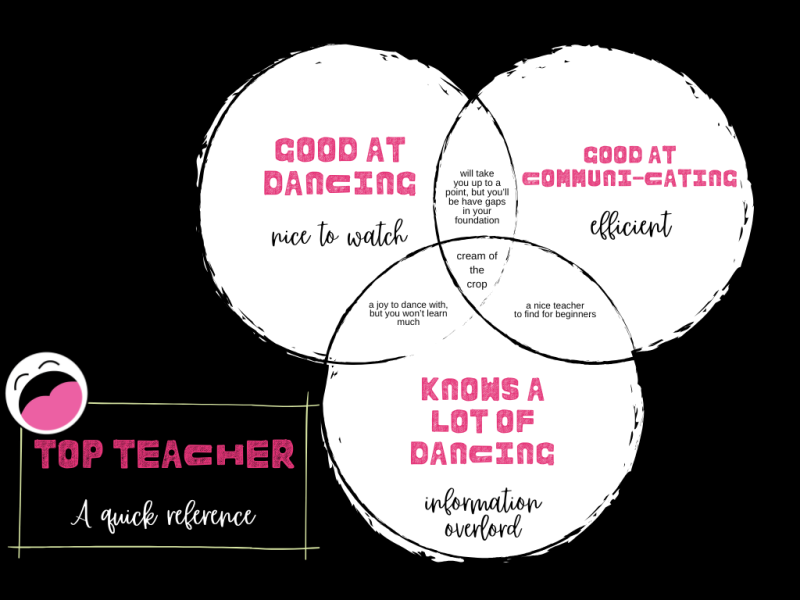
Any ballroom instructor who is making a living is very good at dancing, knows a great deal of information about dancing, and is very effective at communicating.
The rub: even with the best instruction in … instructing, teaching is still a mash-up of clear communication, reading a room/people/person, experience, efficiency, therapy, and LEARNING. To get better at teaching, one must teach. And have it fail, or not exactly succeed. And then learn from that and teach it better the next time. The humility and patience involved is vast. If you have a love of learning and dealing with people, along with passion for dance, ballroom dancing could be the place for you.
What if you don't want to work at a studio? Don't worry, I have another 1000 words about that on deck.


 Riot and Frolic
Leave a comment